The evidence
NASA announced on 9 November that both ESCAPADE spacecraft had completed powered Earth flybys and were heading towards Mars. Each combined an engine burn with a close passage by Earth. Mars arrival is planned for September 2027; the successful manoeuvres do not mean the spacecraft have reached their destination. [1]
The route is unusual. After launching in November 2025, the spacecraft spent time in an Earth-proximity orbit before returning for their departure manoeuvres. NASA says this approach offers greater flexibility over launch timing than a direct journey tied to the recurring alignment of Earth and Mars. The current plan calls for science operations to begin in June 2028, after arrival and orbital adjustments. [1]
Rocket Lab, which built the spacecraft, separately confirmed the burns on 10 November. It identified the twins as Blue and Gold and said the manoeuvres took place on 7 and 9 November. The company emphasised the demands on onboard propulsion and trajectory control. Its account provides a manufacturer’s confirmation of the engineering milestone, not an independent assessment of the mission’s eventual science. [2]
Why two viewpoints matter
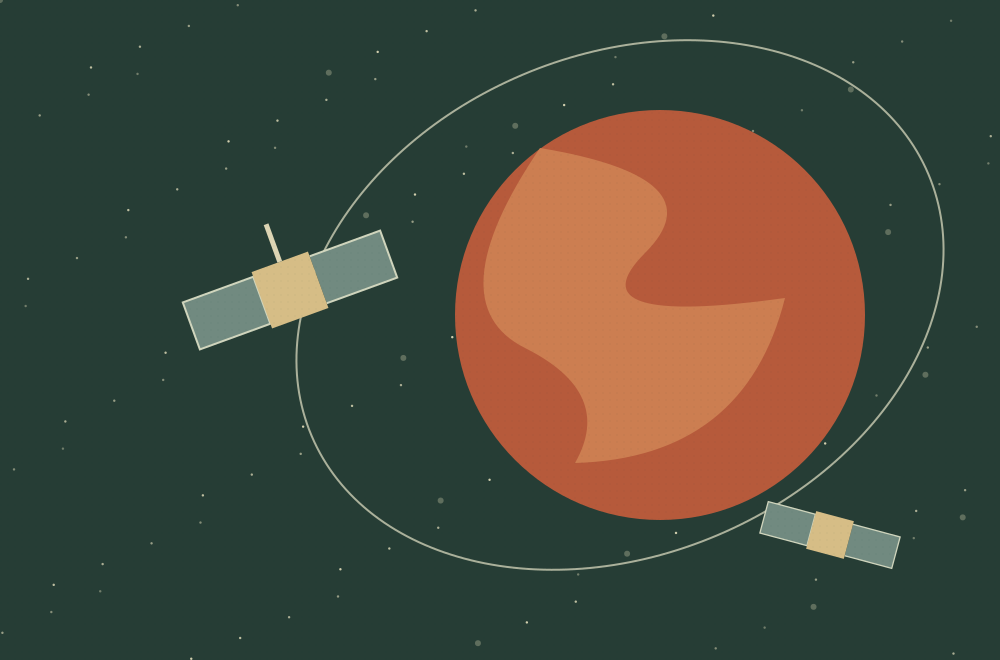
NASA’s mission description explains the scientific objective: measuring how the solar wind interacts with Mars’ magnetic environment and contributes to atmospheric escape. The two spacecraft will first follow each other through similar regions at different times, then operate in different orbits to observe separate regions simultaneously. That design helps researchers distinguish changes over time from differences between locations. [3]
A single spacecraft faces an interpretive problem when its readings change: has the environment evolved, or has the instrument simply moved somewhere different? Coordinated measurements can help disentangle those possibilities. This is the rationale for the twin-spacecraft design, not a claim that the interpretation of every observation will become straightforward.
Our analysis
The mission illustrates how engineering choices shape the questions science can ask. A flexible route may make a launch opportunity usable; a second observing position may reveal relationships hidden from one instrument. Neither advantage is captured by a simple comparison of spacecraft size or a spectacular launch photograph.
There are trade-offs. A longer journey requires continued operations and leaves major manoeuvres ahead. Two spacecraft add coordination demands as well as information. Calling an approach innovative should therefore invite an assessment of what it enables and what new risks it introduces, rather than stand in for that assessment.
Our interpretation is that this mission’s strongest promise is methodological. Understanding how a planetary environment responds to an external influence requires measurements that connect cause and response. The paired observations are designed to improve that connection. They will not, on their own, settle every question about ancient Martian water or habitability.
What to watch
Course corrections, Mars orbit insertion and the transition into coordinated science orbits remain the relevant milestones. The distinction between successful departure and successful science is essential. This month’s manoeuvres materially advance the mission, while the scientific return remains a future result to be earned through operations, measurements and analysis.
Sources & methodology
Primary material consulted for this article. Publication dates refer to the sources; all were checked on 17 November 2026.
- NASA’s ESCAPADE Completes Powered Earth Flybys, Now En Route to Mars ↗NASA · 2026-11-09
- Twin Satellites Complete Successful Trans-Mars Injection Burns ↗Rocket Lab · 2026-11-10
- ESCAPADE mission overview ↗NASA · Undated; checked 2026-11-17
AI-researched and written analysis based on the linked sources. No original interviews or on-the-ground reporting. Forecasts are identified as forecasts; analysis is the publication’s interpretation. Read our editorial standards.